The claim, and why crypto should be its best case
Crypto ought to be the cleanest natural experiment ever run on Thiel's sentence. Source code is public and forkable, so product differentiation has a half-life measured in weeks — anyone can copy the contracts by Friday. If product advantage decays toward zero by construction, distribution should be the only thing that compounds, and the asymmetry should be visible in data rather than argued from anecdote.
On-chain lending is the right test bed: the protocols do the same thing, publish the same numbers, and copy each other's designs openly. The state of the market, annualised from the trailing thirty days:
| Protocol | TVL | Chains | Fees/yr | Revenue/yr | Take rate |
|---|---|---|---|---|---|
| Aave V3 | $13.72B | 22 | $348.6M | $44.9M | 12.9% |
| Morpho Blue | $7.39B | 40 | $321.6M | $0 | 0.00% |
| SparkLend | $3.57B | 2 | $56.3M | — | — |
| Maple | $2.29B | 2 | $116.0M | $13.6M | 11.8% |
| Compound V3 | $1.15B | 9 | $20.3M | $1.1M | 5.6% |
| Euler V2 | $0.31B | 16 | $24.9M | $0.8M | 3.1% |
The received reading is the Thiel reading: Morpho out-distributed Euler by 24× and won; Compound invented the category and lost it. I believed that when I started. It does not survive the population data, and the way it fails is more interesting than the claim.
Why the thesis is mathematically attractive
Under preferential attachment, degree grows as a power of age: position is set by when you arrived, not by what you are. Pólya's urn gives the intuition — the colour fraction is a bounded martingale that converges to a random limit fixed by the early draws. The process is non-ergodic: two runs with identical rules and identical intrinsic merit converge to different market structures, and nothing pulls the system back toward a merit-determined allocation, because no such allocation is an attractor.
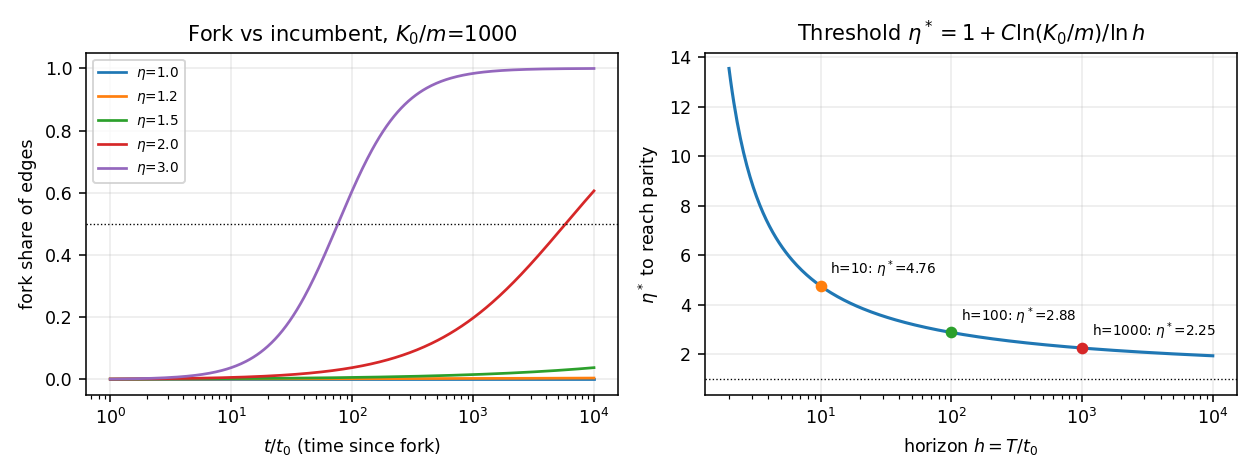
Now the fork. It copies the source, the parameters, the audits — instantiating a node with the incumbent's intrinsic properties and none of its edges. In the Bianconi–Barabási fitness model, racing a fork launched at t0 against an incumbent of degree K0 gives a ratio kf/kinc = (m/K0)(t/t0)(ηf−ηinc)/C.
Corollary. A pure fork has identical fitness, so the exponent vanishes and the deficit is exactly conserved for all time. Copying the node copies none of the edges. Theorem. To reach parity by horizon h, the fork must clear Δη* = C·ln(K0/m)/ln h — at a modest thousand-fold degree deficit, it must be 4.76× fitter to win within one order of magnitude of time, and still 1.94× within four. The threshold decays only as 1/ln h.
That is Thiel's asymmetry as an inequality between exponents rather than an aphorism: degree enters as a multiplicative prefactor, fitness as an exponent. A prefactor advantage is free; an exponent advantage must be manufactured and must be large.
The desk's view: flow is the asset
There is a market where this was settled long ago. Every crypto options desk runs the same model; Black–Scholes–Merton is fifty years old and implemented identically everywhere. There is no model edge and has not been one in a decade — yet P&L is brutally concentrated and every desk marks against one surface. Pulling Deribit's book live (832 BTC instruments, 408,293 BTC of open interest) and regressing relative bid–ask on open interest, controlling for moneyness and tenor, a tenfold increase in open interest tightens the relative spread by about 7.3% (n=643, R²=0.384). Flow is priced into the spread you can charge. Everyone has Black–Scholes; nobody has the order flow.
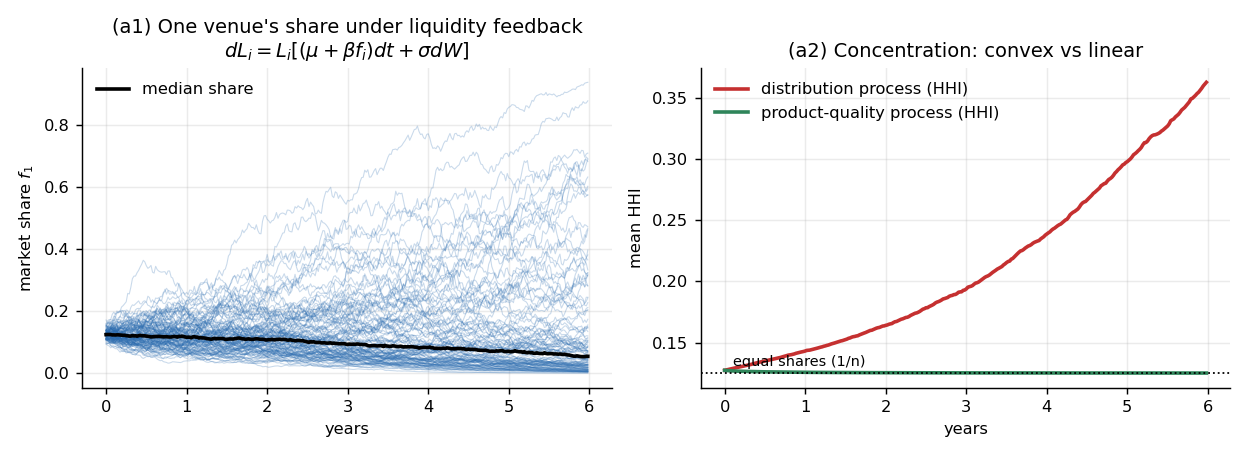
Model it and the asymmetry appears as convexity. A distribution process whose drift increases in its own share has positive gamma — an early, random, undeserved lead compounds instead of decaying. A product process carries a fork term that mean-reverts every copier to the frontier, so quality is bounded above and its dispersion is stationary. Simulating eight firms over 400 paths and six years, terminal concentration is HHI 0.363 for distribution versus 0.125 for product — and 1/n = 0.125 is exactly equal shares. Distribution concentrates; quality does not concentrate at all. You cannot compound a thing your competitor can copy in a weekend.
What the population says
All of that is theory, and both halves of it predict that measurable distribution should predict outcomes. It does not. Regressing log TVL on chain count across the population with age and category controls gives R² ≈ 0.05–0.10. The coefficient is significant and trivial: each additional chain buys about 5% more TVL, so going from one chain to forty predicts well under one order of magnitude against an observed spread of six. Category dummies alone explain more than chain count alone. And regressing revenue on chain count controlling for TVL gives a coefficient statistically indistinguishable from zero.
The census is worse. Of 200 protocols deployed on ten or more chains, median TVL is $9.7M; half hold under $10M and a third under $1M. Broad distribution is a commodity that hundreds of teams have and that almost never produces a win. Meanwhile, among the top 50 protocols by TVL, 20 are on two chains or fewer — and among the top 50 by revenue, 28 are. The more you weight economics, the more winners concentrate in narrow distribution. The relationship does not weaken; it reverses.
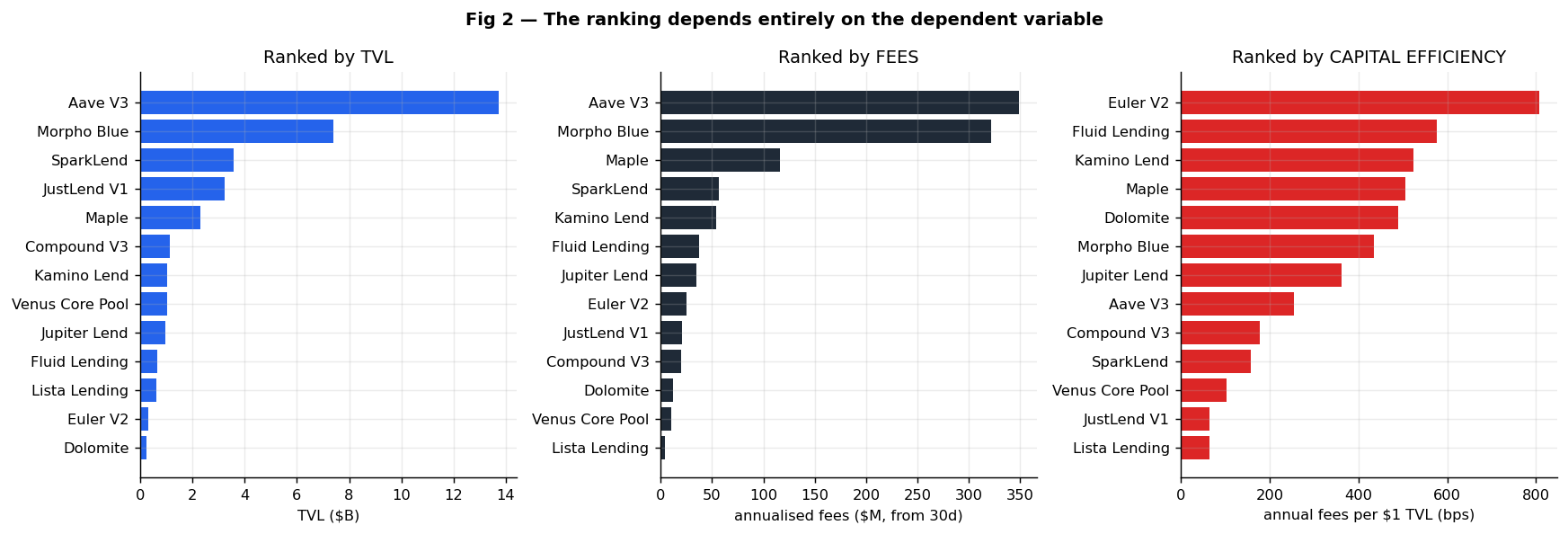
Which exposes the deeper problem: TVL is the wrong dependent variable. Ranked by capital efficiency the table inverts — Euler V2 earns 808bps per dollar of TVL against Aave's 254, ranking 12th of 13 on deposits and 1st of 13 on efficiency, out-earning Compound on a quarter of the TVL. The rank correlation between TVL and efficiency is −0.29 (p=0.33).
The monopolist that captures nothing
Thiel's definition of monopoly is not size. It is the ability to capture supernormal profit. So the correct dependent variable is protocol revenue — and Morpho Blue's is a measured zero over every window the data offers: 24 hours, 7 days, 30 days, one year, and all time.
That deserves scepticism before it carries weight, because a reported zero can mean “untracked” rather than “none.” It does not here: over the same period Morpho's fees are tracked and large — $795k in 24 hours, $26.4M over 30 days. Fees flow and none of them stop. The fee switch is off. Morpho routes roughly $321M a year to lenders and curators and keeps nothing, while Aave captures $44.9M on a comparable fee base.
The flagship monopolist has no pricing power at all. Under Thiel's own criterion Morpho is not a monopoly; it is a commodity utility that achieved scale precisely by refusing to extract rent. That is not a moat — it is a price war, which is what Thiel says undifferentiated commodity businesses are condemned to fight. The essay would be citing Thiel to describe the exact situation Thiel warns against.
And the arrow runs backwards
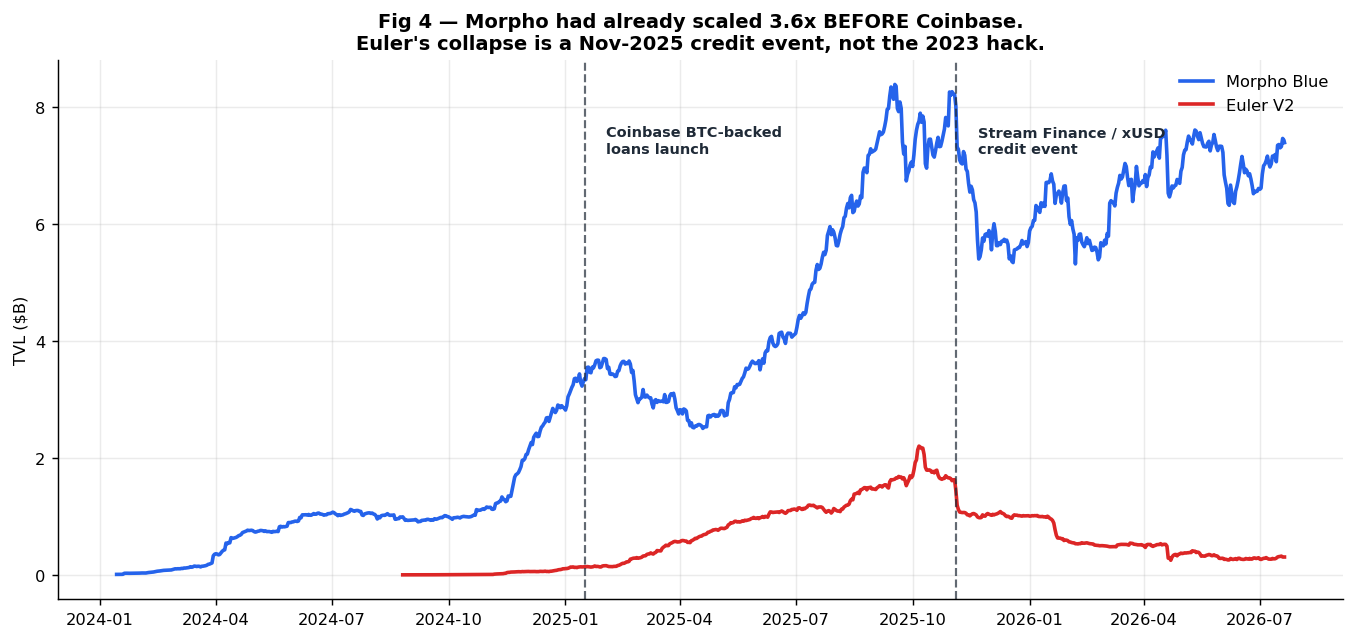
The thesis says Coinbase's distribution made Morpho win. The event study says otherwise: Morpho grew from $0.91B to $3.30B in the seven months before the January 2025 deal (3.63×) and from $3.30B to $7.39B in the eighteen months after (2.24×). It was already the largest lending protocol on Base when Coinbase selected it. Coinbase chose Morpho because Morpho had already won.
The stated reasons were product properties. Coinbase's VP of Engineering, on the minimal core: “Any engineer that looks at these 600 lines of code and really takes the time to understand… all of the people and process and time that that is subbing in for… is awestruck.” A 600-line immutable core is small enough that a reviewing engineer at a regulated public company can hold it entirely in their head — it substitutes for the vendor-risk process. Immutability means an integrator's product cannot be broken by a governance vote, which Aave and Compound structurally cannot offer. And it generalises: across 34 embedders sharing no chain, no investor and no relationship with Base, the rationales rhyme. Base proximity determined who got evaluated first; the minimal immutable core determined who passed.
Both halves of the asymmetry then fail by counterexample. Sufficiency: SushiSwap executed the most famous distribution stunt in DeFi history — the vampire attack that drained Uniswap's liquidity — and sits on 38 chains at $33M today; Blast ran the most aggressive incentive campaign ever mounted and sits at $51M; Euler has BlackRock's sBUIDL and more chains than Compound, and ranks 13th. Necessity: Hyperliquid took zero venture funding, runs about eleven people on a single chain, and earns roughly $478M a year — some ten times Aave, and more than the entire $39.8B lending category combined.
Two supporting cases also dissolve. Compound's decline is organisational, not distributional: its Substrate chain was archived after burning eighteen months of core-team attention, its founder left to build elsewhere and said publicly that institutions were not coming, and a proposal moving ~$24M of treasury to its own proposers passed because the DAO was too disengaged to vote it down. Euler's gap is not the 2023 hack — funds were returned and v2 recovered 639× in thirteen months — but a November 2025 credit event. The contrast is the lesson: Euler lost 100% of user funds and rebuilt; Compound lost none and bled 90%. Trust is recoverable; organisational absence is not.
Finally, the thesis is not falsifiable as posed. “Distribution” equivocates across at least five meanings, and the last of them — the product spread because people wanted it — makes the claim survive every possible observation. Pick the measurable sense and it is false; pick the broad sense and it is vacuous.
What survives
Three things survive contact with the data. Forkability really does erode code-level differentiation — Morpho Blue is 600 lines and has been forked; the code is not the moat. Integration-graph position really does compound and cannot be forked — you can copy the contracts, you cannot copy Coinbase, Crypto.com, Gemini, Kraken and World. And organisational capacity to keep shipping is decisive.
The restatement: in crypto, code-level differentiation is copyable, so the durable advantage is not the contract but the position in the integration graph — being the default that other people's products are built on. That position is earned by product properties that make embedding safe: minimal immutable cores, isolated risk, externalised curation, verifiability. Once earned it compounds, because counterparties cannot be forked. Distribution is the transmission mechanism of a product advantage, not a substitute for one — and bought distribution reliably decays, as Sushi, Blast, and Euler's own $2.2B→$308M round-trip all show.
Two caveats it must not shed. The clearest holder of that position captures zero rent, so it is not yet demonstrably a monopoly in the economic sense — it may be infrastructure rather than a toll road. And none of this is causally identified: the correlation the strong thesis needs is absent, which refutes it, but the reverse causal story rests on timing evidence that is suggestive rather than dispositive.
How persistent is it?
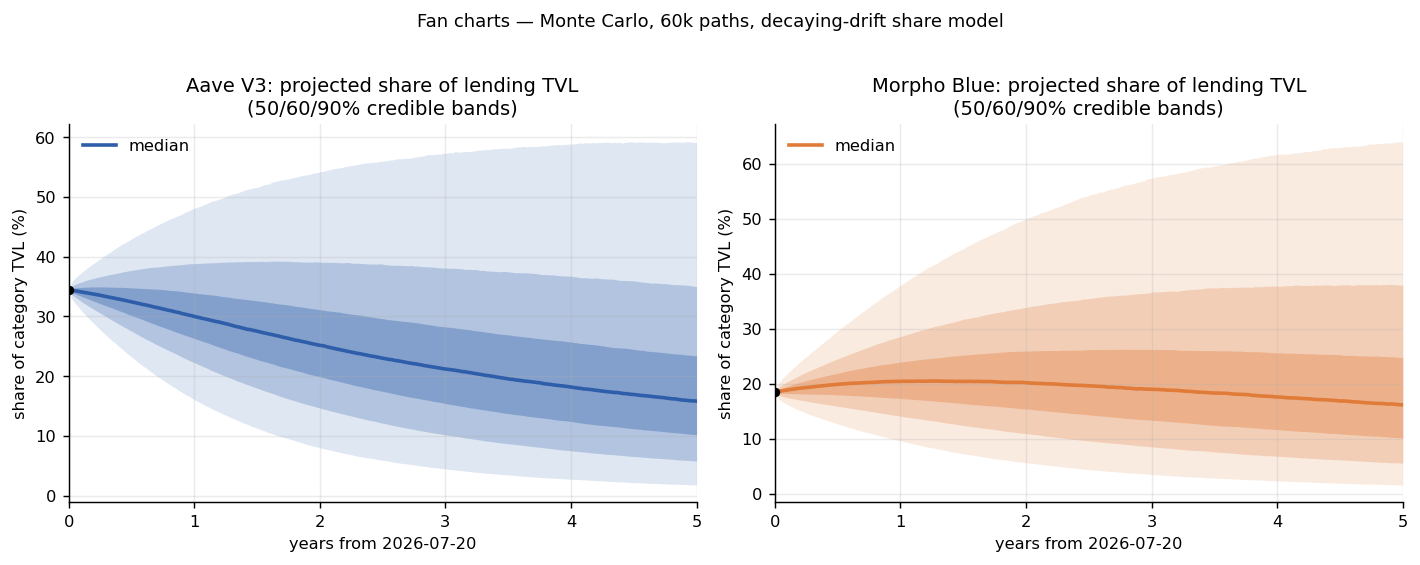
Modelling log-TVL as a common factor plus decaying idiosyncratic drift over 60,000 paths gives P(Morpho Blue TVL > Aave V3 on 2028-07-01) = 41%, interval [23%, 54%] — the spread across 18 hyperparameter configurations, not Monte Carlo error, which would be a false-precision ±0.2%.
That number needed its own correction. The first run gave Aave a drift of −0.349/yr and produced 55%. The cause was the April 2026 bridge exploit that put ~$177M of bad debt into Aave and drove TVL from $26.4B to $11.4B in days; a trailing-twelve-month estimator reads that exogenous jump as trend. Excising the window moves Aave's drift to +0.023/yr, and the gap has been essentially flat since. Roughly half the flippening narrative is one Tuesday in April.
Notice which way that cuts. Aave absorbed a 57% drawdown caused by a third party and its share held. The code lost; the relationships did not. That is better evidence for the compounding of graph position than the raw 24× gap ever was. And the sensitivity analysis deflates the other side equally: at zero drift edge, P(overtake) is still ~23%, so half the headline probability is volatility rather than anyone's momentum.
The practical inversion is the point. If distribution were the moat, the move would be to buy it — chains, incentives, listings, points. The population data say that is the most crowded and least productive trade in the market: hundreds of teams have maximal reach and nothing to show for it, and bought distribution decays on contact. What compounds is being the thing that is safe to be built on, and then letting other people's funnels do the distributing. That is a product instruction, not a marketing budget.
Methods. All market figures code-parsed live from api.llama.fi (/protocols, /overview/fees) and Deribit's /public/get_book_summary_by_currency on 20 July 2026; token market caps from CoinGecko the same day. Simulation code — preferential attachment and the fork threshold, the liquidity/quality SDEs, the integration-call valuation, the population regressions and the 60k-path share model — is Python (numpy/scipy/matplotlib) and reproduces every figure and statistic above. The same essay is also set as a six-page PDF, where the derivations appear in typeset math.
Limitations, in the order they matter. Chain count is a weak proxy for distribution; the strongest form of the thesis concerns embedded partner distribution, which no public dataset measures — that is its best surviving refuge. TVL is a stock, not a flow, and is price × quantity, so shares move without net flow. The lending panel is n=15; the tail fit has 37 points; base-rate windows overlap, giving perhaps 15–20 effective episodes rather than 612. Nothing here is causally identified — there is no instrument for distribution and no exogenous variation. Coinbase's first-party statements were not directly retrievable, so its unmediated rationale is unverified, and embedder quotes come from a vendor surface that controls which quotes are clipped. Forecasts are conditional on no further exploit of the April scale — a base rate of roughly one per two years for a top-3 protocol, worth 10pp or more.
Declared interest: I co-found a credit project whose strategy this analysis directly contradicted. The essay is the result of that contradiction, not a defence against it.